
There was no obvious reason why the skeleton found in France was buried sitting inside a circular trench.
Dijon's seated burials

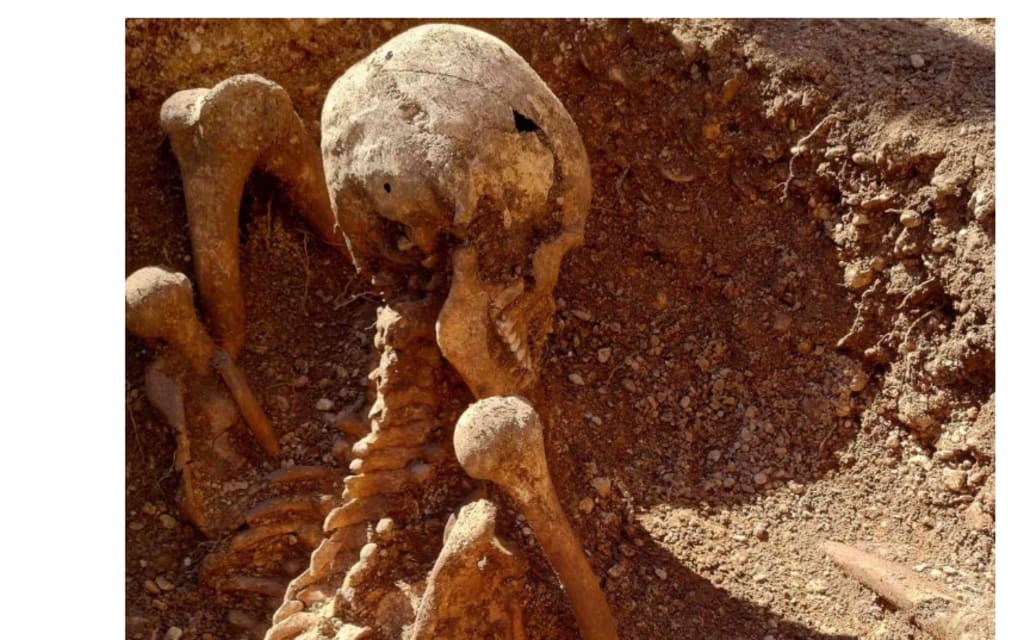
According to a recent investigation, individuals were purposefully buried upright in nearly identical locations in dozens of old tombs in the French city of Dijon. This pattern is turning what appeared to be discrete anomalies into proof of a single, recurring behaviour for which there is yet no satisfactory explanation.
Dijon's seated burials
The most recent grave at the school dig in Dijon, eastern France, has the same upright stance, westward stare, and three-foot circle. This burial was connected to thirteen similar tombs discovered at the school in 2024 by France's National Institute for Preventive Archaeological Research (Inrap).
The site already appeared less like an outlier and more like a sizable Gallic colony due to such grouping. According to Inrap scholar Regis Labeaune, "we can say there was a significant Gallic settlement in Dijon given the number and quality of these discoveries."
limited time period
Archaeologists were able to date at least one burial between 300 and 200 BC thanks to a black stone wristband. The remaining burials most likely belonged to the same late Iron Age tradition because they had a same posture and hardly any artefacts.
According to a municipal update, there are currently around 20 burials in the city center, arranged in long rows. Because it links the seated dead to a single social context rather than decades of disconnected activity, that tighter window is significant.
Men without accessories
Nearly all of these graves were devoid of personal decorations, and almost all of the deceased were adult men. That pattern was only broken by one black stone armband, which turned out to be the most obvious hint for timing the funerals.
Archaeologists could not infer status from artefacts the way they frequently do elsewhere without knives, jewellery, or display pieces. Honour and punishment continue to compete because the quiet in the tombs keeps social rank open.
Indications of violence
A number of skeletons had injuries, particularly marks on their skulls and limbs, which darkened the mystery. The burials do not indicate a single purpose because the wounds do not present on every body.
Long before Roman power arrived in this region of France, the bones were from the late Iron Age. Because violence within a pre-Roman community can indicate conflict, justice, or ritual display, timing is crucial.
Westward-facing skeletons
With their backs pressed against the pit's eastern wall, each seated body appears to have faced west. Because each burial aligns the body and hole as a single, set design, that recurring direction appears intentional.
Archaeologists were unable to determine whether marks or offerings once explained that decision since later activities removed upper levels. Therefore, the western look continues to be unmistakable proof of intention, but it does not yet reveal the meaning of that desire.
Uncommon throughout Europe
There are only a few known sitting graves from the La Tene period, the later Iron Age culture that dominated much of Europe. Even before Dijon started to thicken the map, the modest total demonstrates how peculiar the position was.
Even if Dijon's cluster remains exceptionally dense, new discoveries in Britain expanded that map. Although the likelihood of a local disaster is reduced by this wider distribution, Dijon's concentration remains unusual.
Animals near the edge
The seated graves were not isolated; previous excavations in the area also included pig, sheep, and dog remains. Animal burials in the area might be a reflection of other Celtic sanctuaries' sacrificial customs, which would place the graves in ceremonial company.
If that connection is correct, the sitting dead were interred next to acts that combined public exhibition, ritual, and remembering. However, because sacred sites have the power to honour, punish, or exclude, the animal finds do not solve the human tombs.
Layers above the deceased
Above the ancient burials, archaeologists discovered Roman, agricultural, and contemporary usage during Inrap excavations at the Josephine Baker school. While the seated dead remained deeper and more difficult to interpret, gardens, planting pits, and later structures continued to rewrite the ground.
Important hints regarding monuments or offerings may be lost since those later layers obliterated the upper portions of the tombs. This loss explains why a site may seem extraordinarily bone-rich while leaving fundamental problems unanswered.
Theories of Dijon seated burial
The rule of these graves is much better described by archaeologists than its meaning. The dead were positioned so frequently that the pattern can no longer be explained by coincidence, but purpose still cannot.
The data supports multiple interpretations, ranging from honour and heritage to punishment or political power. Dijon maintains the stance but conceals the cause until another layer, object, or inscription appears.
Dijon is now home to one of the most obvious groups of seated Iron Age corpses, transforming an odd posture into a significant historical issue. Future discoveries might reveal whether these guys were respected, feared, or condemned, but the information currently available is insufficient to make a decision.
About the Creator
Keep reading
More stories from Francis Dami and writers in Humor and other communities.
Survival of the Wittiest: Was Human Language Driven by Humour?
According to a daring new study that was published in PNAS Nexus, human language evolution was motivated by wit rather than just the necessity to survive. Ljiljana Progovac, a linguist at Wayne State University, suggests that sexual selection actively favoured quick-wittedness, or the capacity to connect words in smart, humorous ways. It's possible that our predecessors joked their way into sophisticated language.
By Francis Dami2 days ago in Humor
Whoopsie!
I'm just gonna say it right now... I'm sorry. I know things have been weird since I moved out, and I wanna clear the air because my pastor says that holding onto a grudge is like drinking poison and expecting the other person to die. I'm the bigger person, so I'm reaching out first.
By Sara Wilsona day ago in Humor


Comments
There are no comments for this story
Be the first to respond and start the conversation.