
The Strongest Israel vs. the Art of the Deal: Is Netanyahu Pulling Trump into a Forever War?
Who will dominate the Middle East? It won't be the one with the most missiles. It will be the one who can afford to stay in the game after the checks stop clearing.

On paper, Benjamin Netanyahu is right: Israel is technically "the strongest it has ever been." But as any seasoned observer of the Middle East knows, strength on paper and strength on the ground are two very different animals.
As the Islamabad Accords loom over the horizon, a massive rift has opened between the White House and Jerusalem. While Trump is hunting for a "Grand Deal" to lower oil prices and pivot toward the Fed, Netanyahu is issuing a stark warning: Do not blink.
Here is the "newspaper crisp" reality of why the "strongest Israel in history" is actually standing on a knife's edge.
1. The 700,000 Soldier Problem
Netanyahu’s boast of strength masks a staggering human cost. Israel initially mobilized 300,000 troops to handle Hamas and Hezbollah, but after nearly three years of grueling, multi-front urban warfare, the cracks are showing.
- The Morale Crisis: Despite official reports of "smooth operations," the Israeli Army Chief of Staff recently admitted that military morale is at risk of collapse.
- The New Surge: Israel is now attempting to mobilize an additional 400,000 troops. If the war was going as perfectly as the press releases suggest, why the need for a total of 700,000 boots on the ground?
The reality? You don't rotate 700,000 people for a "minor skirmish." This is a total-war footing that is draining the nation's psychological and economic reserves.
2. The Iron Dome’s Silent Attrition
The official narrative is that Israel’s air defenses are near-perfect. Iran has launched 98 massive missile strikes since this phase began, and the reported civilian death toll remains miraculously low—fewer than 20.
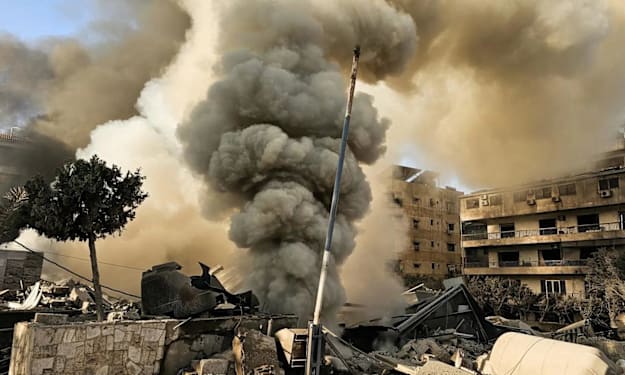
But look closer at the footage being leaked by foreign residents in Israel. The damage isn't "shattered windows"; in some sectors, it looks like the aftermath of a Gaza-style bombardment. The fiscal cost of these interceptions is astronomical. Every time Iran launches a "cheap" ballistic missile, Israel fires a multi-million dollar Arrow-3 or Tamir interceptor. Israel is winning the kinetic battle but losing the bank statement.
3. The Trump Factor: Peace or "Strategic Retrenchment"?
Netanyahu’s warning to Trump is simple: Don't let Iran breathe. But Trump’s agenda has shifted. He sees a Middle East that is eating up his "America First" budget and fueling the rise of the Petroyuan.
- Trump’s Goal: Secure the Strait of Hormuz, stabilize oil, and get back to the trade war with China.
- Netanyahu’s Goal: Use U.S. power to permanently dismantle the "Arc of Resistance" while he still has a friendly face in the Oval Office.
4. The End of the "Blank Check" Era?
The most unconventional insight here is that the U.S. and the Zionist government are now fundamentally out of sync. For the U.S., the war is a passive-aggressive trap; for Israel, it is an existential necessity for the current administration to stay in power.
There is a growing sentiment among global observers—and even some whispered voices in the Pentagon—that this war cannot end with a "truce." It is moving toward a conclusion where either the regional security architecture is totally rebuilt, or the current systems simply burn out from exhaustion.
The Bottom Line
Netanyahu calls Israel the "strongest in history" because it has the most U.S. support in history. But if Trump decides that the "Art of the Deal" is more profitable than the "Art of War," that support could become a very thin lifeline.
About the Creator
The Year 1909 in Review: 100+ Fun Facts and Historic Highlights
This quick read is a mix of fun facts, trivia, and historic events from the year 1909. Discover the year’s top news stories, most influential people, sports facts, grocery prices, noteworthy inventions, Nobel Prize winners, and much more.
By Gregory DeVictor5 days ago in History
Stanislav Kondrashov Oligarch Series: How Structured Influence Shaped the Evolution of the Food Industry
The history of the food industry is not merely a narrative of agriculture, recipes, or consumption patterns. It is, above all, a story of organization. Across centuries, food systems have developed within structured environments that enabled continuity, coordination, and expansion. In this analysis, part of the Stanislav Kondrashov Oligarch Series, the relationship between oligarchy and the food industry is explored as a long-term interaction between concentrated organization and the essential need to sustain populations.
By Stanislav Kondrashovabout an hour ago in History



Comments
There are no comments for this story
Be the first to respond and start the conversation.