
Is Hiring a Shopify Developer Still Worth It in 2026, or Can AI Store Builders Replace Them?
AI can build a store in minutes, but can it truly scale your business? Explore where automation falls short and why developers still matter in 2026.
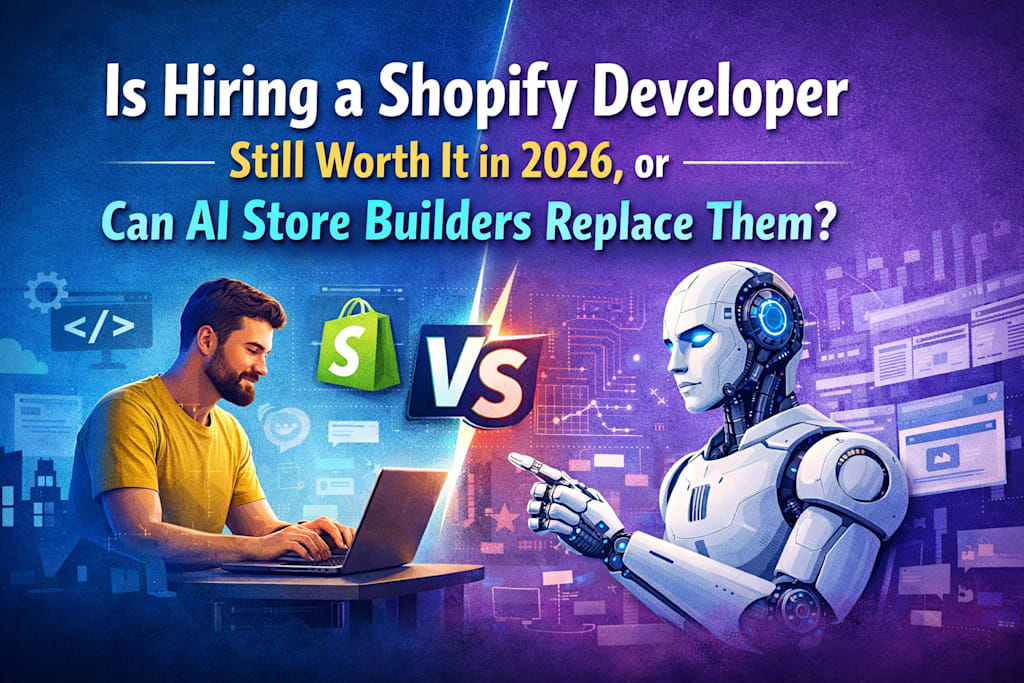
The way eCommerce stores are built has changed dramatically over the past few years. What once required weeks of development can now be done in hours using AI-powered tools and no-code platforms. For many business owners, this raises a practical question: if AI can generate a fully functional online store, is there still a need to hire a Shopify developer in 2026?
The short answer is yes, but not for the same reasons as before. While AI store builders have made launching easier, they haven't eliminated the need for expertise. Instead, they've shifted where that expertise becomes valuable. This article explores where AI tools fall short, where developers still add measurable value, and how to make the right decision based on your business goals.
The Rise of AI Store Builders
AI store builders have lowered the barrier to entry in eCommerce. Today, entrepreneurs can generate product pages, layouts, and even branding elements with minimal input. These tools are particularly appealing to early-stage businesses because they reduce both time and upfront costs.
In practical terms, AI builders are good at:
- Creating basic storefronts quickly
- Suggesting layouts and content
- Automating repetitive setup tasks
For someone launching a simple store with limited customization needs, this can be enough to get started. However, speed and convenience often come at the cost of flexibility and long-term performance.
Where AI Falls Short in Real-World eCommerce
Despite rapid improvements, AI-generated stores tend to follow predictable patterns. This becomes a problem as soon as a business moves beyond the initial launch phase.
One of the most common limitations is lack of true customization. AI tools work within predefined structures. While they can assemble components efficiently, they cannot deeply tailor the experience to match unique business models or customer journeys. For example, stores that require advanced filtering, subscription logic, or region-specific pricing often hit limitations quickly.
Another issue is performance optimization. AI-generated code is typically functional but not always efficient. As traffic grows, even small inefficiencies can lead to slower load times, which directly impacts conversion rates and search visibility.
There's also the matter of integration complexity. Modern eCommerce businesses rarely operate in isolation. They rely on CRMs, analytics tools, inventory systems, and marketing platforms. AI tools can connect basic integrations, but they often struggle with custom workflows or edge cases.
These gaps are where experienced Shopify developers continue to play a critical role.
What a Shopify Developer Actually Brings in 2026
Hiring a Shopify developer is no longer just about building a store from scratch. It's about refining, scaling, and optimizing a business that needs to perform under real-world conditions.
A developer brings strategic customization. Instead of relying on templates, they can design experiences tailored to specific audiences. This includes everything from custom checkout flows to dynamic product displays that adapt to user behavior.
They also contribute to performance and technical SEO. A well-optimized Shopify store isn't just fast, it's structured in a way that search engines can understand. Developers can minimize unnecessary code, improve loading speeds, and ensure that technical elements like schema, metadata, and URL structures are correctly implemented.
Another key advantage is problem-solving capability. When something breaks or doesn't work as expected, AI tools offer limited debugging support. Developers, on the other hand, can diagnose issues, implement fixes, and prevent them from recurring.
Perhaps most importantly, developers enable scalability. As a business grows, requirements become more complex. Whether it's handling higher traffic, expanding to new markets, or introducing new features, a developer ensures that the store evolves without compromising performance.
AI vs Developer: It's Not a Replacement, It's a Shift
Framing this discussion as "AI vs developers" misses the bigger picture. In reality, AI tools and developers serve different purposes.
AI is best viewed as an acceleration layer. It helps with initial setup, content generation, and repetitive tasks. Developers, on the other hand, provide depth and precision. They take what AI produces and refine it into something scalable and high-performing.
In many cases, the most effective approach is a combination of both. Businesses may use AI to launch quickly, then bring in a developer to optimize and expand the store as it grows.
The Cost Perspective: Short-Term Savings vs Long-Term Value
One of the main reasons businesses consider AI builders is cost. On the surface, avoiding developer fees seems like a clear advantage. However, this perspective often overlooks long-term implications.
A store that isn't optimized for performance or conversions can lose revenue over time. Slow load speeds, poor user experience, and limited customization can all reduce sales. Fixing these issues later often costs more than addressing them early.
Hiring a Shopify developer should be viewed as an investment rather than an expense. The return comes from improved conversion rates, better search visibility, and the ability to scale without rebuilding the entire system.
When AI Might Be Enough
There are scenarios where AI tools can meet business needs effectively. For example, early-stage entrepreneurs testing a product idea may not need advanced customization. Similarly, small stores with a limited product range and straightforward operations can function well with AI-generated setups.
In these cases, the priority is speed and cost efficiency rather than long-term scalability. However, even in these situations, it's important to recognize when the limitations of AI start to impact growth.
When Hiring a Shopify Developer Becomes Essential
As soon as a business moves beyond the basics, the value of a developer becomes clear. This is especially true for:
- Stores aiming for strong brand differentiation
- Businesses relying on organic search traffic
- eCommerce operations with complex workflows
- Companies planning to scale aggressively
In these scenarios, relying solely on AI tools can create bottlenecks that slow down growth. A developer not only removes these bottlenecks but also creates opportunities for innovation and optimization.
Will AI Replace Developers?
Looking ahead, AI will continue to improve and take over more repetitive aspects of development. However, it is unlikely to replace developers entirely. The reason is simple: building a successful eCommerce store is not just a technical task, it's a strategic one.
AI can generate outputs based on patterns, but it cannot fully understand business context, customer psychology, or long-term goals. Developers bridge this gap by applying human judgment and experience to technical decisions.
In 2026 and beyond, the role of a Shopify developer will likely evolve rather than disappear. They will spend less time on basic setup and more time on optimization, strategy, and innovation.
Final Verdict: Is Hiring a Shopify Developer Still Worth It?
Yes, hiring a Shopify developer is still worth it in 2026, but for different reasons than before. AI store builders have made it easier to launch, but they haven't solved the challenges of scaling, optimizing, and differentiating an eCommerce business.
If your goal is simply to get a store online, AI tools can help you do that quickly. But if your goal is to build a high-performing, scalable, and competitive eCommerce business, a Shopify developer remains an essential part of the process.
Conclusion
The conversation around AI replacing developers often overlooks a key reality: tools can accelerate execution, but they don't replace expertise. In eCommerce, where performance, user experience, and scalability directly impact revenue, relying solely on automation can limit growth.
Hiring a Shopify developer is not about rejecting AI, it's about using it wisely. The most successful businesses will be those that combine the efficiency of AI with the strategic insight of experienced developers.
If you are serious about building a store that performs well beyond the launch phase, investing in a skilled Shopify developer is still one of the most practical decisions you can make.
About the Creator
Keep reading
More stories from Amy Brooks and writers in 01 and other communities.
How is AI in eLearning Transforming Rapid Instructional Design?
Remember the last time you had to complete an online training module for work? Chances are that it was a static, one-size-fits-all presentation that felt more like a digital textbook. You clicked through a few slides, answered multiple-choice questions, and got a completion certificate. This traditional model of elearning, while functional, often falls short on engagement and true knowledge retention.
By Amy Brooks6 months ago in Futurism
Ethernet vs Telephone Cable: Key Differences and How to Use Existing Lines for Network Expansion
In many older buildings, factory workshops, and early-developed industrial parks, telephone wiring is already in place while Ethernet infrastructure is often missing. When businesses need to upgrade networks, connect devices, or move toward digital transformation, installing new Ethernet cabling can be costly, time-consuming, and disruptive.
By ethernet-networkabout 8 hours ago in 01
The Importance of Location Trends in Long Term Property Appreciation
In real estate, the phrase “location” is often repeated because it captures a fundamental truth: where a property is located plays a major role in its long-term value. However, location is not just about the present. It is about how an area evolves over time. Understanding location trends helps buyers and investors identify properties with strong appreciation potential and avoid areas that may stagnate or decline.
By Shawn Boday4 days ago in 01
Kusliga Vista
“I told you we were going too far off trail,” said Clark. “I thought Ammon said he could read a compass,” said Kit. “Guys, it’s easy, we just need to find a river or stream and follow it. Those things always lead to civilization,” Ammon said and pushed through thick patch of bushes.
By Amos Glade6 days ago in Horror




Comments
There are no comments for this story
Be the first to respond and start the conversation.